
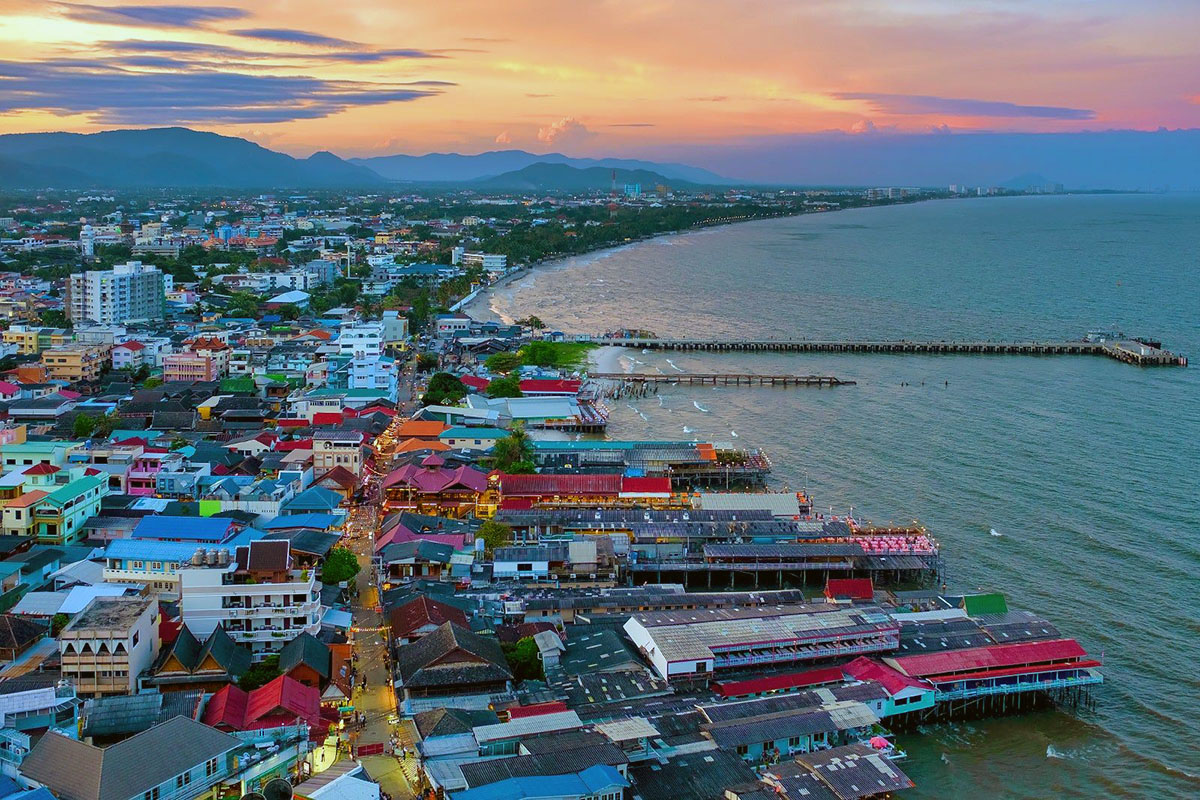
Hua Hin is a relaxed seaside town on Thailand’s western Gulf coast, known for its long sandy beach, traditional seafood restaurants, lively evening markets, and historic connections with the Thai royal family. Located approximately 200 kilometres south of Bangkok, it has developed from a small fishing community into one of the country’s best-known coastal resorts, attracting Thai weekend visitors, international travellers, and people looking for a quieter alternative to Thailand’s busier beach destinations. Its appeal comes from a combination of seaside relaxation and everyday local life, with traditional markets, cafés, temples, golf courses, and restaurants spread along the coastline. The town centre is relatively compact, while the surrounding area offers viewpoints, mangrove forests, royal heritage sites, and national parks that are worth exploring beyond the beach. Two or three nights are generally sufficient for a relaxed visit, although four or five days allow time for excursions and a slower pace. The most comfortable period is usually from November to February, when temperatures are slightly cooler and rainfall decreases, while March to May can be particularly hot. September and October are generally the wettest months, although Hua Hin tends to receive less annual rainfall than many other Thai coastal destinations.
Main Transport Hubs
✈️ Hua Hin Airport (HHQ)
Hua Hin Airport is a small regional airport located approximately six kilometres north of the town centre, along Phetkasem Road. Unlike Thailand’s larger tourist airports, it handles only a limited number of scheduled passenger services, with Thai AirAsia operating direct flights between Hua Hin and Chiang Mai. The route increased to daily service for the 2026/27 winter schedule, although frequencies can change seasonally. There are no scheduled flights connecting Hua Hin with Bangkok, and international passenger connections remain extremely limited. For most travellers arriving from abroad, Bangkok’s Suvarnabhumi Airport (BKK) and Don Mueang Airport (DMK) are therefore the principal gateways, followed by an overland journey to Hua Hin. Transfers from Bangkok generally take around three to four hours by road, depending on traffic and the departure point, while the nearby Hua Hin Airport is useful mainly for travellers arriving from northern Thailand.
🚉 Hua Hin Railway Station
Hua Hin Railway Station is one of the most practical arrival points for visitors travelling by train, located within walking distance of the town centre and its main restaurants and markets. It serves Thailand’s Southern Railway Line, with connections towards Bangkok and destinations farther south, including Surat Thani and other cities along the southern railway corridor. The station underwent a major change in December 2023, when passenger services moved to a new elevated station building as part of the railway modernisation project. The historic red-and-cream wooden station, famous for its traditional architecture and royal waiting pavilion, remains nearby as a heritage attraction but is no longer used for boarding trains. Visitors should make sure to use the modern station for departures and arrivals. Services from Bangkok include ordinary and faster trains, with journey times varying considerably according to the train category and departure station.
🚌 Hua Hin Bus Station
Hua Hin Bus Station, near the junction of Phetkasem Road and Hua Hin Soi 96, is an important departure point for long-distance coaches operated by companies such as Sombat Tour and other interprovincial operators. It serves connections towards Bangkok, including services to the Southern Bus Terminal, along with selected routes towards other Thai destinations. Located south of the central tourist streets, near the Bluport shopping area, it is relatively easy to reach by songthaew or taxi. Hua Hin also has numerous private minivan operators using different offices and pickup points, including services towards Bangkok and nearby towns. Because the boarding location depends on the operator, travellers should follow the address indicated on their ticket rather than assuming that every bus or minivan departs from the same terminal.
🚍 Roong Reuang Airport Coach Terminal
The Roong Reuang Coach terminal, located along Phetkasem Road near Hua Hin Airport, is particularly important for travellers arriving from or departing to Bangkok Suvarnabhumi Airport. The operator runs direct air-conditioned coaches between the airport and Hua Hin, allowing passengers to avoid travelling into central Bangkok before continuing towards the coast. The journey generally takes around four hours, although road conditions can affect arrival times. This terminal is several kilometres north of central Hua Hin and should not be confused with Hua Hin Bus Station near Soi 96. Travellers arriving by coach will normally need a separate taxi, ride-hailing service, or local transfer to reach their accommodation. Advance booking is advisable during weekends and Thai public holidays, when travel between Bangkok and Hua Hin can be particularly busy.
Getting Around Hua Hin
Hua Hin is easier to navigate than Thailand’s larger cities, but its attractions are spread along a relatively long coastal strip. Walking is practical in the town centre, while the main road and surrounding neighbourhoods are served by shared songthaews, taxis, and ride-hailing services. Travellers staying in more remote resorts or planning excursions to national parks will generally need additional transport.
🚶 Walking Around Hua Hin
Walking is the simplest way to explore central Hua Hin, particularly around the railway station, Chatchai Market, Hua Hin Night Market, and the streets leading towards the beach. Numerous restaurants, cafés, shops, and guesthouses are located within a relatively compact area, making it possible to enjoy the centre without relying on transport. However, some pavements are narrow or obstructed, and Phetkasem Road carries considerable traffic. Hua Hin’s beachfront also offers opportunities for long walks, particularly at low tide when the sand becomes wider and firmer. The beach is not accompanied by a continuous pedestrian promenade, so access depends on the location and the tide.
🚐 Green Songthaews
Green songthaews are one of Hua Hin’s most practical and inexpensive forms of local transport. These converted pickup trucks operate along the main coastal corridor, connecting central Hua Hin with Nong Kae and Khao Takiab, passing close to shopping areas, restaurants, and the weekend markets. Passengers can generally flag down a passing vehicle, tell the driver where they want to go, and pay the fare when getting off. Services are inexpensive compared with taxis, although routes, frequencies, and fares should be confirmed locally. They generally operate during the daytime and early evening, becoming less frequent later at night. For visitors staying near Phetkasem Road, songthaews are particularly useful for travelling between the centre and attractions south of town without renting a vehicle.
🚕 Taxis, Tuk-Tuks, and Ride-Hailing Apps
Grab and Bolt operate in Hua Hin and provide convenient ways to arrange local transport, particularly for journeys between hotels, restaurants, and attractions outside walking distance. App-based bookings allow visitors to see a quoted fare before confirming the journey, making them useful alternatives to negotiating directly with a driver. Traditional tuk-tuks and private taxis can also be found around tourist areas, hotels, and transport hubs, although fares are usually agreed upon before departure rather than calculated using a meter. These options are particularly practical for visiting Khao Takiab, travelling to outlying resorts, or returning from the evening markets after songthaew services have finished. For attractions farther inland, arranging a driver for a return trip is often more convenient than relying on finding transport at the destination.
🛵 Scooters and Rental Cars
Renting a scooter or car can be useful for travellers planning to explore the countryside around Hua Hin, especially attractions such as Pranburi Forest Park, royal heritage sites, and Khao Sam Roi Yot National Park. Scooter rental shops operate around the central tourist districts, while car rental services are available through local and national companies. However, Phetkasem Road is a busy highway, and some smaller roads have limited lighting or uneven surfaces. Scooter riding requires experience, a helmet, an appropriate motorcycle licence, and valid driving documents for Thailand. Visitors should also verify their insurance coverage and inspect the vehicle before accepting a rental. For inexperienced riders, a rental car or arranged driver is generally a safer way to explore attractions outside town.
Things to See and Do in Hua Hin
🏖️ Hua Hin Beach
Hua Hin Beach is the town’s principal attraction, stretching for several kilometres along the Gulf of Thailand towards the rocky headland of Khao Takiab. Unlike the tropical beaches of Thailand’s southern islands, Hua Hin is characterised by a broad, gently sloping shoreline, shallow coastal waters, and a relatively urban setting backed by hotels, resorts, and residential buildings. The beach is particularly enjoyable for walking in the early morning, when temperatures are cooler and the sand is often firm enough for long strolls. Horse riding is a traditional activity associated with Hua Hin, and visitors may encounter operators offering rides along selected sections of the shore. Swimming is possible when sea conditions are suitable, although water clarity varies and the beach becomes considerably narrower at high tide, sometimes disappearing in front of certain beachfront properties. Hua Hin Beach is best appreciated for its open coastal atmosphere, long walks, and relaxed resort character rather than for crystal-clear water or isolated tropical scenery.
🚉 Historic Hua Hin Railway Station
The historic Hua Hin Railway Station is one of the town’s most recognisable landmarks and an important reminder of its development as a royal seaside resort. The traditional wooden buildings are distinguished by their red-and-cream colours, decorative architectural details, and connections with the Thai monarchy. One of the most notable features is the royal waiting pavilion, associated with the period when railway travel helped make Hua Hin a fashionable destination for members of the royal family and Bangkok society. The original station buildings are now preserved as part of Hua Hin’s heritage, while regular passenger services operate from the newer elevated station nearby. Visiting the historic station is a relatively brief experience, but its central location makes it easy to combine with the town’s traditional markets and shopping streets. It is particularly appealing to travellers interested in Thai railway history and architecture.
🛕 Khao Takiab and Wat Khao Takiab
Khao Takiab, commonly known as Monkey Mountain, is a rocky headland approximately seven kilometres south of central Hua Hin, marking the southern end of the main beach. The hill is famous for its large golden standing Buddha overlooking the sea and Wat Khao Takiab, a Buddhist temple complex reached by a steep staircase and a winding road. From the elevated viewpoints, visitors can enjoy sweeping views along Hua Hin’s coastline, particularly during clear weather. The surrounding area also contains a small fishing community, seafood restaurants, and quieter stretches of beach, making it worthwhile beyond the temple itself. The hill is home to numerous macaques, which are accustomed to visitors but remain wild animals and can behave aggressively around food and loose belongings. Early morning is a pleasant time to visit, both for the cooler temperatures and the coastal scenery. Appropriate clothing is expected within the temple grounds.
🛍️ Hua Hin Night Market
Hua Hin Night Market is one of the town’s most popular evening attractions, located along Dechanuchit Road, near the central railway and shopping district. As evening approaches, the street fills with food stalls, seafood restaurants, clothing vendors, souvenir stands, and small shops selling a mixture of traditional products and tourist-oriented merchandise. The market is particularly known for its grilled seafood displays, where visitors can choose prawns, fish, squid, and other ingredients prepared to order. The atmosphere is lively but generally more relaxed than the enormous night markets found in Bangkok, making it convenient for a casual dinner or evening walk. Unlike Hua Hin’s weekend creative markets, the central Night Market operates throughout the week, although the number of vendors and level of activity may vary. Its location within walking distance of numerous central hotels makes it an easy introduction to Hua Hin’s evening food and shopping scene.
🎨 Cicada Market and Tamarind Market
Cicada Market is one of Hua Hin’s most distinctive attractions, combining art, handicrafts, independent design, food, and live entertainment in an open-air setting in Nong Kae, south of the town centre. Unlike an ordinary souvenir market, Cicada places particular emphasis on handmade products, artwork, creative businesses, and performances, with small stalls arranged around landscaped spaces and exhibition areas. The market normally opens on Friday, Saturday, and Sunday evenings, making it especially popular with weekend visitors from Bangkok. Immediately nearby, Tamarind Market offers a different but complementary experience, focusing primarily on casual food stalls, outdoor seating, drinks, and live music. Tamarind generally operates from Thursday to Sunday evenings. Visiting both markets together is an enjoyable way to spend an evening, with Cicada offering more opportunities for browsing and Tamarind providing a comfortable setting for dinner. The markets are several kilometres south of central Hua Hin, so visitors staying downtown will generally need a songthaew or taxi.
🌄 Khao Hin Lek Fai Viewpoint
Khao Hin Lek Fai, also known as Flintstone Hill, is a viewpoint located approximately three kilometres west of central Hua Hin. Rising above the surrounding town, the hill contains several observation points offering panoramic views across Hua Hin’s rooftops, beaches, and coastline, with the Gulf of Thailand stretching into the distance. A road leads towards the summit area, making it accessible by taxi, private vehicle, or scooter without requiring a long hike. Short walking paths connect the different viewpoints, although some sections have uneven surfaces and exposed areas. The hill is particularly attractive in the early morning, when the light is softer and visibility is often better. It is one of the simplest ways to appreciate Hua Hin’s geography, with the narrow coastal town extending between the sea and the inland hills.
🖌️ Hua Hin Artists Village (Baan Sillapin)
Hua Hin Artists Village, also known as Baan Sillapin, is a small creative community located in the hills west of the town centre. Established as a place for artists to work, exhibit, and share their creations, it contains galleries, studios, workshops, and spaces displaying paintings, sculptures, ceramics, and other forms of art. Visitors can browse the exhibitions, watch artists working, and participate in selected creative activities, including painting workshops suitable for adults and children. The landscaped surroundings and informal atmosphere make it an enjoyable alternative to Hua Hin’s beaches and markets, particularly for travellers interested in art and independent local businesses. The village is located outside the central walking area and is most conveniently reached by taxi or private transport. It generally opens from Tuesday to Sunday, with Mondays reserved as a closing day, although exhibition schedules and workshop availability can vary.
👑 Maruekhathaiyawan Palace
Maruekhathaiyawan Palace, sometimes written as Mrigadayavan Palace, is an elegant former royal summer residence located on the coast north of Hua Hin, towards Cha-am. Built during the reign of King Rama VI in the early twentieth century, the palace is particularly notable for its raised wooden pavilions, long covered corridors, and architectural design intended to encourage natural ventilation in the tropical climate. Unlike more monumental royal residences, its charm lies in the lightness of its structures, their pastel colours, and the relationship between the buildings, surrounding gardens, and sea. The palace offers an interesting perspective on Hua Hin’s development as a royal resort and is particularly appealing to travellers interested in Thai history and traditional architecture. Parts of the complex have undergone restoration, and public access has operated under restricted visiting schedules, so checking the current opening days and available areas before travelling is important. Modest clothing is required, as expected at royal heritage sites.
🌳 Pranburi Forest Park
Pranburi Forest Park is an attractive natural area approximately 25 kilometres south of Hua Hin, known for its mangrove forests, coastal vegetation, and peaceful scenery. One of its main attractions is an elevated wooden boardwalk extending through the mangroves, allowing visitors to observe the intricate network of roots, tidal channels, and plant life without disturbing the fragile environment. The trail is relatively easy to explore and provides an interesting introduction to the coastal ecosystems of the Gulf of Thailand. Depending on water levels and local operating conditions, small boat excursions may also be available along the waterways. The park is considerably quieter than central Hua Hin and is particularly enjoyable for nature lovers, families, and travellers looking for a short excursion away from the resort areas. Public transport connections are limited, so arranging a private vehicle or driver is usually the most practical way to visit.
🏞️ Khao Sam Roi Yot National Park and Phraya Nakhon Cave
Khao Sam Roi Yot National Park, located approximately 60 kilometres south of Hua Hin, is one of the region’s most remarkable natural destinations, characterised by dramatic limestone mountains, wetlands, beaches, and caves. Its most famous attraction is Phraya Nakhon Cave, an enormous natural chamber containing the elegant Khuha Kharuehat Pavilion, a small royal structure dramatically illuminated when sunlight enters through an opening in the cave ceiling. Reaching the cave requires travelling to the coastal village of Bang Pu, continuing to Laem Sala Beach by boat or a rocky coastal trail, and then climbing a steep forest path towards the cave entrance. The journey involves considerable physical effort, particularly in hot or humid weather, so suitable footwear and water are essential. Early morning is generally preferable, both for the temperature and the possibility of seeing sunlight illuminate the pavilion, although lighting depends on weather and the season. The park is best explored as a dedicated day trip, with transport arranged in advance and local trail conditions checked before departure.
Where and What to Eat in Hua Hin
Hua Hin’s food culture is closely connected with its coastal location, making fresh seafood one of the main reasons to explore the town’s restaurants and markets. Grilled prawns, steamed fish, squid, crab, and spicy seafood dishes are widely available, particularly around the Night Market, the fishing pier, and Khao Takiab. Alongside seafood, visitors will find traditional Thai-Chinese eateries, small breakfast restaurants, local food courts, and familiar Thai dishes from different regions of the country. Hua Hin also has a growing selection of international restaurants and cafés, reflecting its popularity among long-term foreign residents and domestic holidaymakers.
🦐 Thai Seafood and Local Dishes to Try
- Pla Pao: Whole fish grilled in a salt crust, usually served with fresh herbs, vegetables, and a spicy seafood dipping sauce.
- Pu Pad Pong Karee: Stir-fried crab in a fragrant yellow curry sauce, often prepared with egg, onion, and other seasonings.
- Tom Yum Talay: A spicy and sour Thai soup made with mixed seafood, lemongrass, galangal, lime leaves, and chilli.
- Pad Cha Talay: Mixed seafood stir-fried with fresh peppercorns, chilli, herbs, and aromatic spices, known for its bold flavours.
- Pla Neung Manao: Steamed fish served with a sharp, spicy dressing made from lime juice, garlic, chilli, and fish sauce.
- Hoi Lai Pad Nam Prik Pao: Stir-fried clams prepared with roasted chilli paste, garlic, and fragrant herbs.
- Khao Tom: Thai rice soup, commonly served for breakfast with pork, fish, or seafood, particularly popular in traditional Thai-Chinese eateries.
These dishes are not exclusive to Hua Hin, but the town’s proximity to fishing communities makes seafood an especially important part of the local dining experience. Fresh seafood is often sold by weight, so visitors should check the total price before ordering larger fish, prawns, crab, or other market-priced items.
🍢 Street Food and Local Markets
Hua Hin Night Market
The central Night Market is one of the most convenient places to sample local seafood and familiar Thai street food. Visitors can choose grilled fish, prawns, squid, fried rice, noodle dishes, roti, fruit, and other snacks while walking between the stalls. The market is particularly lively in the evening and offers a casual dining experience, although some seafood restaurants cater heavily to tourists and may charge more than ordinary neighbourhood eateries.
Tamarind Market
Located near Cicada Market in Nong Kae, Tamarind Market is particularly suitable for a relaxed outdoor dinner. Its food stalls offer a mixture of Thai specialities, grilled meats, seafood, international dishes, desserts, and drinks, with communal seating and live music creating an informal atmosphere. It is a good option for couples, families, and groups who want to try different foods without choosing a single restaurant.
Chatchai Market
Chatchai Market, in central Hua Hin, is one of the town’s traditional daytime markets and an interesting place to observe everyday shopping activity. Vendors sell fresh seafood, vegetables, fruit, meat, herbs, and other local ingredients, while nearby stalls and small restaurants provide breakfast and inexpensive meals. Visiting in the morning offers a more local experience than the evening tourist markets and provides an insight into the ingredients used in the town’s restaurants.
🍽️ Notable Restaurants and Local Eateries
Jek Piek: Traditional Thai-Chinese Breakfast
Jek Piek, also known as Jek Pia, is one of Hua Hin’s long-established local eateries, located near the central market area. Known for its traditional Thai-Chinese atmosphere, it serves familiar breakfast dishes such as rice porridge, noodles, traditional coffee, and other simple preparations. The restaurant has a busy, informal setting that attracts local residents as well as visitors, making it particularly interesting for travellers who want to discover Hua Hin’s everyday food culture beyond the seafood restaurants. It is most convenient for breakfast or an early meal, although some evening service is also offered.
Baan Itsara: Seafood by the Sea
Baan Itsara is an established beachfront seafood restaurant on Naeb Kehardt Road, north of Hua Hin’s main tourist centre. Its appeal comes from the combination of traditional Thai seafood cooking and a relaxed setting overlooking the Gulf of Thailand. The menu includes fresh fish, crab, prawns, soups, and stir-fried dishes prepared for sharing, making it particularly suitable for families or groups who want to order several specialities. The restaurant is generally more expensive than simple local food stalls, but its longstanding reputation and seaside location make it an attractive option for a leisurely meal.
Lung Ja Seafood: Night Market Dining
Lung Ja Seafood is a popular seafood restaurant located within Hua Hin’s central Night Market area. Its open-air setting, lively atmosphere, and displays of fresh seafood make it a characteristic choice for visitors looking for an informal evening meal. Customers can select from prawns, fish, squid, shellfish, and other ingredients prepared with traditional Thai seasonings. The restaurant is especially convenient for travellers staying in the town centre who want to combine dinner with a walk through the market. Prices depend on the type and quantity of seafood ordered, so confirming the cost before preparation is advisable.
Aow Takiab Seafood: Coastal Thai Cooking
Aow Takiab Seafood is a well-known restaurant in the Khao Takiab and Ao Hua Don area, south of central Hua Hin. It specialises in Thai seafood dishes, including grilled and steamed fish, prawns, spicy soups, and stir-fried preparations, served in a relaxed coastal environment. Its location makes it particularly convenient for visitors exploring the temple, fishing community, and beaches around Khao Takiab. The restaurant is popular with groups and families, offering an opportunity to enjoy a traditional shared seafood meal away from the busier central Night Market.
Jaras Hua Hin: Contemporary Thai Cuisine
Jaras Hua Hin, located at the InterContinental Hua Hin Resort, offers a more refined approach to Thai cuisine, with a focus on regional ingredients, fresh seafood, and contemporary interpretations of traditional recipes. The restaurant places particular emphasis on locally sourced produce and carefully prepared dishes, presented in an elegant beachfront setting. It is considerably more expensive than ordinary seafood restaurants or market stalls, making it particularly suitable for a special dinner or travellers interested in exploring the more sophisticated side of Thai gastronomy.
Where to Stay in Hua Hin
Hua Hin offers a broad range of accommodation, from inexpensive guesthouses and small independent hotels to comfortable beachfront resorts, serviced apartments, and luxury properties. The most important decision is whether to stay within walking distance of the town centre or choose a quieter resort farther south. Unlike a large city, Hua Hin does not require an extensive breakdown of neighbourhoods, but the differences between its central area and the southern beachfront can significantly affect the experience.
🏖️ Hua Hin Town Centre: Restaurants, Markets, and Convenience
Central Hua Hin is the most practical area for visitors who want to explore the town without relying heavily on transport. Accommodation around the railway station, Night Market, central beach access points, and surrounding streets provides convenient access to restaurants, cafés, shops, bars, and everyday services. Hotels range from budget guesthouses and independent properties to comfortable resorts and established beachfront establishments. Staying in the centre is particularly suitable for first-time visitors, couples, and travellers arriving by train or bus who want to spend their evenings walking between restaurants and markets. Streets close to the Night Market and bars can be noisy, while beachfront hotels may offer a quieter atmosphere but should be checked carefully for their actual walking distance from central attractions.
🌴 Nong Kae: Beach Resorts and Weekend Markets
Nong Kae, south of central Hua Hin, is an attractive choice for travellers looking for a more resort-oriented stay while remaining within reasonable reach of restaurants and local attractions. The area contains numerous beachfront hotels, modern resorts, apartment-style properties, and comfortable accommodation, with some establishments offering direct access to quieter sections of the beach. Cicada Market and Tamarind Market are located in this part of Hua Hin, making the neighbourhood particularly appealing for visitors who enjoy relaxed evenings, outdoor dining, and weekend markets. The main town centre is several kilometres away, so green songthaews or ride-hailing services are generally useful for sightseeing and dining farther north. Nong Kae is particularly suitable for couples, families, and travellers who prefer spending more time at their hotel or on the beach.
🛕 Khao Takiab: Quieter Beaches and Coastal Atmosphere
Khao Takiab, at the southern end of Hua Hin’s main coastal strip, offers a more relaxed alternative to the busiest central tourist districts. The area is characterised by beaches, small seafood restaurants, residential streets, and accommodation ranging from simple guesthouses to modern beachfront resorts. Its proximity to Wat Khao Takiab and the surrounding fishing community makes it particularly appealing for travellers interested in a quieter coastal setting rather than shopping and nightlife. Some sections of the beach are less crowded than those closer to central Hua Hin, although conditions and available space depend on the tide. Reaching the Night Market and central attractions generally requires a songthaew or taxi, so Khao Takiab is best suited to visitors who prioritise beach time, tranquillity, and a slower pace of travel.
Useful Tips
Plan ahead for weekends and Thai public holidays. Hua Hin is a popular short-break destination for Bangkok residents, so hotels, restaurants, roads, and evening markets can become considerably busier from Friday to Sunday. Booking accommodation and longer-distance transport in advance is particularly advisable during holiday periods.
Carry some cash for markets and local meals. Smaller restaurants, street food stalls, traditional markets, and local songthaew services may prefer cash payments. Small Thai baht banknotes are particularly useful for inexpensive purchases and short transport journeys.
Check the location of your hotel carefully. Hua Hin covers a long stretch of coastline, and accommodation advertised as being in Hua Hin may be several kilometres from the town centre. Some beachfront properties have limited access to nearby streets or restaurants, so checking walking distances and available transport is important, especially when staying without a car.
Safety and Local Considerations
Sea conditions and tides deserve attention when visiting Hua Hin’s beaches. The width of the shoreline changes considerably between low and high tide, and strong winds or rougher seas can make swimming unsafe during certain periods. Visitors should follow any warning flags or local safety instructions, avoid swimming during severe weather, and remain alert for jellyfish, which can occasionally occur along this part of the Gulf coast. Beach activities such as horse riding should be arranged with established operators, with the route, duration, and total price agreed upon in advance.
The macaques around Khao Takiab are another local consideration. Although visitors often approach them for photographs, they are wild animals capable of biting, scratching, and snatching food or loose belongings. Avoid feeding or touching them, keep bags securely closed, and do not carry visible food when visiting the temple grounds. Any bite or scratch should be cleaned promptly and assessed by a medical professional because of the risk of infection and potential rabies exposure.
Road safety is particularly important along Phetkasem Road and on the smaller roads leading towards inland attractions. Traffic can be fast-moving, pedestrian crossings are not always respected, and some routes have limited lighting after dark. Travellers without motorcycle experience should avoid renting scooters simply because they are readily available. During periods of heavy rain, roads and natural trails can also become slippery, so excursions to forests, caves, and national parks should be planned according to current weather conditions.
Hua Hin: Thailand’s Relaxed Royal Coast
Hua Hin has a different rhythm from Thailand’s larger beach resorts, shaped by its long coastline, royal heritage, and longstanding popularity among Thai holidaymakers. Its markets, seafood restaurants, and everyday streets give the town a familiar, lived-in atmosphere, while the surrounding hills and national parks offer a change of scenery beyond the beach. It is a destination best enjoyed without a crowded itinerary, leaving time for coastal walks, leisurely meals, and exploring the countryside at a comfortable pace.
Continue exploring
 RouteHow to Get from Bangkok to Chiang Mai
 RouteHow to Get from Vientiane to Nong Khai
 RouteHow to Get from Bangkok to Ayutthaya
 RouteHow to Get from Chiang Mai to Pai
 RouteHow to Get from Siem Reap to Bangkok
 RouteHow to Get from Bangkok to Hua Hin
 RouteHow to Get from Chiang Mai to Bangkok
 RouteHow to Get from Bangkok to Pattaya
 RouteHow to Get from Pattaya to Hua Hin
 GuideBangkok Travel Guide
 GuidePai Travel Guide
 GuideChiang Mai Travel Guide